
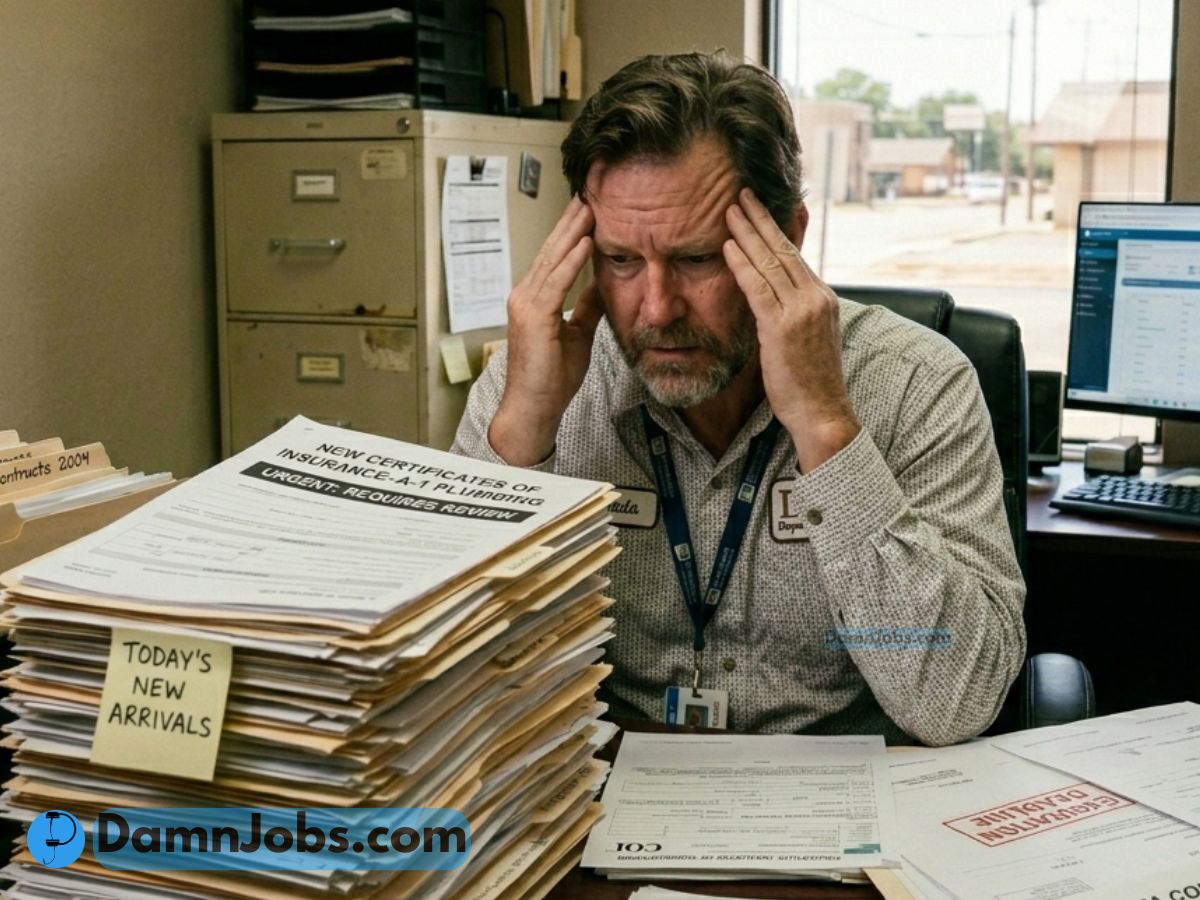
In the fast-growing Dallas-Fort Worth metroplex, commercial construction projects move at a breakneck pace. With hundreds of subcontractors, suppliers, and independent operators flowing through local jobsites daily, paperwork backlogs build up rapidly. Among all operational documents, none carries more financial weight than the Certificate of Insurance (COI).
Failing to verify, organize, and monitor vendor compliance documentation shifts 100% of the legal and financial liabilities directly onto your business. This structural operational guide provides a practical blueprint for audit preparation, document categorization, and automated operational habits designed specifically for Texas contractors.
The Cost of Non-Compliance: Understanding Financial Risk Exposure
Many general contractors incorrectly assume that a signed contract containing an indemnification clause offers full legal protection. However, if a subcontractor lacks active General Liability or Workers’ Compensation insurance at the exact moment an incident occurs, those structural clauses can become functionally unenforceable due to the subcontractor’s lack of capital. At that point, the entire burden transfers to your corporate policy premiums.
Your firm’s Total Financial Risk Exposure (Rtotal) across active operational jobsites can be modeled as:
Where Vn represents the total contract financial value of vendor n, Cn is the intrinsic risk coefficient based on their trade scope (e.g., roofing or structural framing vs. interior painting), and Plapse represents the historical probability of an unmonitored compliance paper lapse.
Anatomy of a High-Risk Paperwork Backlog
Data compiled from thousands of commercial contractor compliance audits reveals that the vast majority of operational gaps stem from just four root administrative processing vulnerabilities. The chart below details the statistical distribution of standard vendor compliance errors found during structural project cleanups:
Step-by-Step Vendor Document Cleanup Framework
To safely clean up an inherited or neglected compliance paper backlog without disrupting ongoing field production, your internal operations staff must execute a methodical, multi-tiered document evaluation strategy.
Step 1: Risk-Stratify Your Active Vendor Directory
Not all sub-tier vendors carry equal structural risks. Treating a commercial mechanical or roofing subcontractor with the same operational administrative urgency as an office cleaning service overburdens your staff. Segment your roster into distinct tiers to optimize manual audit bandwidth:
| Vendor Classification | Trade & Operational Examples | Minimum Coverage Target | Audit Priority Level |
|---|---|---|---|
| Tier 1: High Risk | Roofing, Structural Steel, Demolition, Excavation | $5M+ Aggregate / Umbrella | CRITICAL (Immediate) |
| Tier 2: Medium Risk | HVAC, Plumbing, Electrical, Framing, Drywall | $2M General Liability | HIGH (Within 14 Days) |
| Tier 3: Low Risk | Interior Finishes, Janitorial, Material Supply Drops | $1M General Liability | STANDARD (Routine) |
Step 2: Enforce a Rigorous Digital Filing Architecture
Physical paper filing cabinets and scattered email attachments are the primary drivers of compliance blindspots. Migrate all incoming records to a secure, centralized cloud workspace (such as SharePoint, Google Workspace, or purpose-built tracking platforms). Implement a strict, machine-readable file naming convention across all folders:
[VendorName]_[DocumentType]_[YYYY-MM-DD_Expiration]
Example: LoneStarSteel_COI_2026-11-15.pdf. This uniform structural format allows administrative personnel to immediately sort documents by real-time expiration date, making upcoming renewal tracking straightforward.
Step 3: Audit Content Authenticity and Verbiage
A COI is merely an informational snapshot; it is not an active insurance policy. When cleaning your archive, cross-verify that your corporate legal entity is specifically named as an “Additional Insured” via an attached policy endorsement form (typically CG 20 10 or CG 20 37 forms). Verify that the issuing insurance brokerage listed in the top right corner is legitimate, and proactively audit high-risk policies directly with the agent if signatures appear irregular.
Implementing Long-Term Automation Habits
Executing an isolated compliance document cleanup provides temporary protection, but systemic lapses will inevitably recur unless your workflows shift toward proactive prevention. Configure an automated notification cadence to trigger continuous verification updates:
- 60 Days Prior to Expiration: Automated warning notice dispatched to the subcontractor’s compliance contact.
- 30 Days Prior to Expiration: Second automated reminder requesting the updated certificate shell.
- 14 Days Prior to Expiration: Telephone outreach by administrative team; alert flags attached to upcoming field payroll draws.
- Day of Expiration: Automatic system freeze preventing field access or payment distribution until updated papers are uploaded.
Localized Solutions for North Texas Construction Teams
Navigating localized municipal mandates and complex commercial contract layers across the Dallas, Fort Worth, and Frisco corridors demands specialized knowledge. If your internal team lacks the available bandwidth to manually audit historical files, check out the specialized insights available at damnjobs.com/vendor-compliance-paperwork-cleanup-for-dfw-contractors/ to discover customized tactical frameworks tailored specifically for regional commercial contracting operations.