
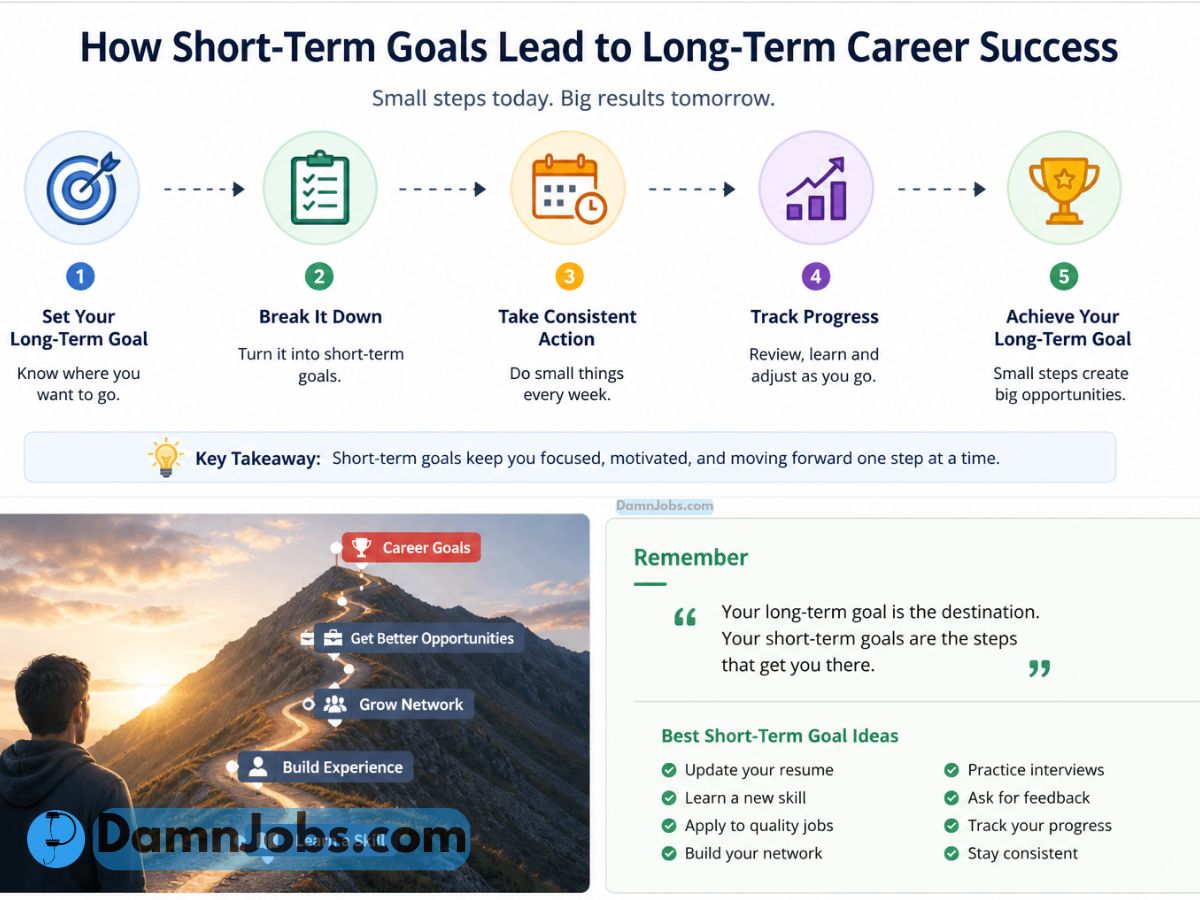
Quick Answer
Short-term goals help you reach long-term career goals by turning big dreams into small actions you can actually finish. Each small goal builds skills, confidence, experience, and momentum until the bigger career goal becomes realistic.
How Short-Term Goals Help You Reach Long-Term Career Goals
Introduction: Big Career Dreams Need Small Daily Moves
Long-term career goals sound exciting.
You may want to land a better job, change careers, earn more money, work remotely, start freelancing, become a manager, or finally leave a job that makes you feel stuck.
But here is the truth most people forget:
Big career goals do not happen from one big move. They happen from many small, smart moves repeated over time.
That is where short-term goals come in.
Short-term goals are the steps you can take today, this week, or this month. Long-term career goals are the bigger results you want in the future. When the two are connected, your career finally starts moving with direction instead of guesswork.
Think of it like building a bridge. Your long-term goal is the other side. Your short-term goals are the planks that help you cross without falling through.
What Are Short-Term Career Goals?
Short-term career goals are small goals you can usually complete in a few days, weeks, or months.
They are practical, clear, and close enough that you can actually take action.
Examples of short-term career goals include:
| Short-Term Goal | Why It Matters |
|---|---|
| Update your resume this week | Helps you apply faster when opportunities appear |
| Apply to 5 targeted jobs | Builds momentum and increases your chances |
| Learn one new skill | Makes you more valuable in your field |
| Message 3 people in your industry | Opens doors you may not find on job boards |
| Practice interview answers | Builds confidence before the real interview |
| Finish a certification module | Moves you closer to a stronger resume |
| Improve your LinkedIn profile | Helps recruiters understand your value quickly |
Short-term goals are not random tasks. They are career building blocks.
Before you apply to more jobs, make sure your resume is clear, targeted, and easy for hiring managers to understand.
What Are Long-Term Career Goals?
Long-term career goals are bigger achievements that usually take months or years.
They give your career direction.
For extra career-planning help, CareerOneStop has a helpful guide to set career goals and connect your next steps to the kind of work you want.
Examples include:
| Long-Term Career Goal | What It May Require |
|---|---|
| Become a cybersecurity analyst | Skills, certifications, projects, applications |
| Move into management | Leadership experience, communication skills, results |
| Get a remote job | Strong resume, remote-friendly skills, targeted applications |
| Earn a higher salary | Better positioning, stronger skills, negotiation |
| Change careers | Learning, networking, portfolio, patience |
| Start a freelance business | Clients, offers, pricing, marketing |
| Build financial stability | Consistent income growth and career planning |
Long-term goals give you the “why.”
Short-term goals give you the “how.”
The Simple Connection: Short-Term Goals Create Long-Term Results
Here is the easiest way to understand it:
| Long-Term Career Goal | Short-Term Goals That Lead There |
|---|---|
| Get a better job | Update resume, apply weekly, practice interviews, improve LinkedIn |
| Change careers | Research roles, learn skills, build portfolio, connect with people |
| Earn more money | Track achievements, improve skills, apply to higher-paying roles |
| Become a manager | Lead small projects, improve communication, ask for feedback |
| Work remotely | Target remote-friendly companies, build digital skills, show independence |
| Start freelancing | Pick a service, create samples, reach out to first clients |
Your short-term goals are not “small” in value. They are small in size so you can actually do them.
That is what makes them powerful.
Why Short-Term Goals Work So Well
1. They Make Big Goals Less Overwhelming
Saying “I want a better career” can feel too big.
But saying “I will update my resume by Friday” feels doable.
That one small action creates movement.
Then you can apply to jobs.
And, then you can get interviews.
Then you can improve your answers.
Then you can get offers.
Small steps reduce fear because they make the goal feel real.
If you feel stuck in a job you hate, short-term goals can help you create an exit plan without making a rushed decision.
Career Goal Roadmap
Big career goals become easier when you break them into smaller steps you can take every week.
1. Choose the Goal
Decide where you want your career to go.
2. Break It Down
Turn the big goal into weekly actions.
3. Build Skills
Learn what your next role actually needs.
4. Take Action
Apply, practice, network, and improve.
5. Track Progress
See what works and adjust your plan.
2. They Help You Build Career Momentum
Momentum matters.
When you complete one small goal, you feel more capable. That confidence makes it easier to complete the next goal.
For example:
| Week | Small Career Action | Result |
|---|---|---|
| Week 1 | Rewrite resume summary | Resume looks stronger |
| Week 2 | Apply to 10 better-fit jobs | More targeted applications |
| Week 3 | Practice interview answers | Better confidence |
| Week 4 | Message 5 professionals | More possible connections |
By the end of one month, you are not just “thinking about your career.”
You are actively improving it.
3. They Show You What Is Working
Short-term goals give you feedback.
If you apply to 30 jobs and get no interviews, that tells you something. Maybe your resume needs work. Or, maybe your target jobs are too broad. Maybe your keywords are missing.
If your resume is not getting interviews, start by improving your resume before sending more applications.
If you get interviews but no offers, that tells you something else. Maybe your interview answers need stronger examples.
Short-term goals help you test, learn, and adjust.
That is much better than waiting one year and wondering why nothing changed.
4. They Build Skills Before You Need Them
Many people wait until they desperately need a job before they start improving their resume, skills, network, or confidence.
That is stressful.
Short-term goals help you prepare before pressure hits.
For example, if your long-term goal is to become a team leader, you can start now by:
| Skill Needed Later | Short-Term Goal Today |
|---|---|
| Leadership | Volunteer to lead one small task |
| Communication | Practice writing clearer emails |
| Problem-solving | Document how you fixed an issue |
| Confidence | Speak up once in a meeting |
| Organization | Use a weekly task tracker |
You become ready by practicing before the big opportunity arrives.
The Best Short-Term Goals Are Connected to a Bigger Career Vision
Not every goal is useful.
A short-term goal only helps if it moves you closer to something important.
For example:
| Weak Goal | Stronger Goal |
|---|---|
| “Apply to jobs.” | “Apply to 5 remote cybersecurity jobs that match my skills.” |
| “Fix my resume.” | “Rewrite my resume summary to target IT manager roles.” |
| “Learn something.” | “Complete one LinkedIn Learning course on project management.” |
| “Network more.” | “Message 3 people who work in companies I want to join.” |
The stronger version is specific. It has direction.
That is what keeps you from wasting energy.
A Simple Formula for Setting Career Goals
Use this formula:
Long-term goal + short-term action + deadline = real progress
Here are examples:
| Long-Term Goal | Short-Term Action | Deadline |
|---|---|---|
| Get a remote job | Apply to 5 remote roles | By Friday |
| Become a manager | Ask to lead one small project | This month |
| Change careers | Research 3 target job titles | Today |
| Earn more | List 10 measurable achievements | This week |
| Improve resume | Rewrite work experience bullets | By Sunday |
| Build confidence | Practice 5 interview answers | Before next interview |
Deadlines matter because they turn wishes into action.
Remote jobs are competitive, so your short-term goal should be to apply with a stronger resume, not just a higher number of applications.
Career Goal Planning Table
Here is a simple table readers can copy and use:
| My Long-Term Career Goal | Why I Want It | Short-Term Goal This Week | Short-Term Goal This Month | How I Will Measure Progress |
|---|---|---|---|---|
| Example: Get a remote job | More flexibility and better pay | Update resume | Apply to 20 targeted roles | Number of interviews |
| Example: Become a manager | More leadership and income | Ask for feedback | Lead one project | New responsibilities |
| Example: Change careers | Better future opportunities | Research roles | Finish beginner course | Skills learned |
This is the kind of table that keeps people on the page because it feels useful, not just informational.
Example: Turning a Long-Term Goal Into Short-Term Steps
Let’s say your long-term goal is:
“I want to get a better-paying job in the next 12 months.”
That sounds big.
Now break it down:
| Timeframe | Goal |
|---|---|
| Today | Write down your target job titles |
| This week | Update your resume and LinkedIn |
| This month | Apply to 20 targeted jobs |
| Next 3 months | Build one new skill or certification |
| Next 6 months | Track interviews, improve answers, expand networking |
| Next 12 months | Land a stronger role or negotiate better pay |
Now the goal has a path.
You are not just hoping.
You are building.
Common Mistake: Setting Goals That Are Too Big Too Soon
One reason people give up is because they set goals that are too large without a plan.
For example:
“I want to change my whole career in 30 days.”
That may sound motivating, but it can quickly become frustrating.
A better version:
“This month, I will choose one career path, learn the top 5 skills required, and update my resume for that direction.”
That is realistic.
And, that is measurable.
That is useful.
Career growth works better when you stop trying to change everything overnight and start changing the right things consistently.
If you are changing careers, start by learning which skills appear again and again in job descriptions. You can also use the U.S. Department of Labor’s O*NET Career Exploration Tools to research occupations, skills, interests, and career paths.
Common Mistake: Having Short-Term Goals With No Long-Term Direction
Some people stay busy but do not move forward.
They apply to random jobs.
They take random courses.
And, they rewrite their resume again and again.
So, they scroll job boards for hours.
That feels like work, but it may not lead anywhere.
Before choosing short-term goals, ask:
| Question | Why It Helps |
|---|---|
| What career do I actually want? | Gives direction |
| What skills does that career require? | Shows what to learn |
| What experience am I missing? | Shows what to build |
| What kind of companies should I target? | Improves job search focus |
| What can I do this week? | Creates action |
Busy is not the same as strategic.
Short-Term Goals Can Also Protect Your Confidence
Career growth can feel emotional.
Rejection hurts.
Job searching is tiring.
Changing careers can feel scary.
Waiting for results can make you question yourself.
Short-term goals help because they give you something you can control.
You cannot control whether one company calls you back.
But you can control:
| What You Can Control |
|---|
| How strong your resume is |
| How many targeted applications you send |
| How often you improve your skills |
| How prepared you are for interviews |
| How clearly you explain your value |
| How consistently you show up |
That is powerful.
When you focus on controllable actions, you stop feeling completely stuck.
30-Day Career Goal Action Plan
Here is a simple 30-day plan readers can follow.
| Week | Focus | Action Steps |
|---|---|---|
| Week 1 | Clarity | Choose target role, review job descriptions, list missing skills |
| Week 2 | Resume | Update resume, add keywords, improve work experience bullets |
| Week 3 | Visibility | Update LinkedIn, connect with people, apply to targeted jobs |
| Week 4 | Improvement | Practice interviews, track results, adjust your strategy |
This is simple enough for real life.
Not perfect.
Not overwhelming.
Just useful.
Best Short-Term Career Goals to Start With
Here are strong short-term goals that can help almost anyone:
| Goal | Why It Helps |
|---|---|
| Update your resume | Makes you ready for opportunities |
| Improve your LinkedIn headline | Helps recruiters understand you fast |
| Apply to 5 quality jobs per week | Builds steady job search momentum |
| Learn one in-demand skill | Makes your resume stronger |
| Write down your career achievements | Helps with resumes and interviews |
| Practice interview stories | Makes you sound more confident |
| Ask for feedback | Shows you what to improve |
| Build a small portfolio | Proves what you can do |
| Track job applications | Helps you see patterns |
| Remove distractions | Gives your career plan more focus |
The goal is not to do all of these at once.
Pick one. Finish it. Then pick the next one.
Keep Building Your Career Plan
If you are serious about reaching your long-term career goals, start with the basics that move the needle:
Final Takeaway
Short-term goals are how long-term career goals become real.
You do not need to figure out your entire future today. You just need to choose the next smart step.
Update the resume.
Learn the skill.
Apply to the better job.
Practice the interview.
Send the message.
Track the result.
Adjust the plan.
That is how careers change.
Not usually overnight.
Not by luck alone.
But by small goals that point in the right direction again and again.
Your long-term career goal is the destination. Your short-term goals are the road.
Start with the next mile.
Ready to Take the Next Career Step?
Your long-term career goal starts with one short-term action. Start by making sure your resume is strong, clear, and ready for better opportunities.