
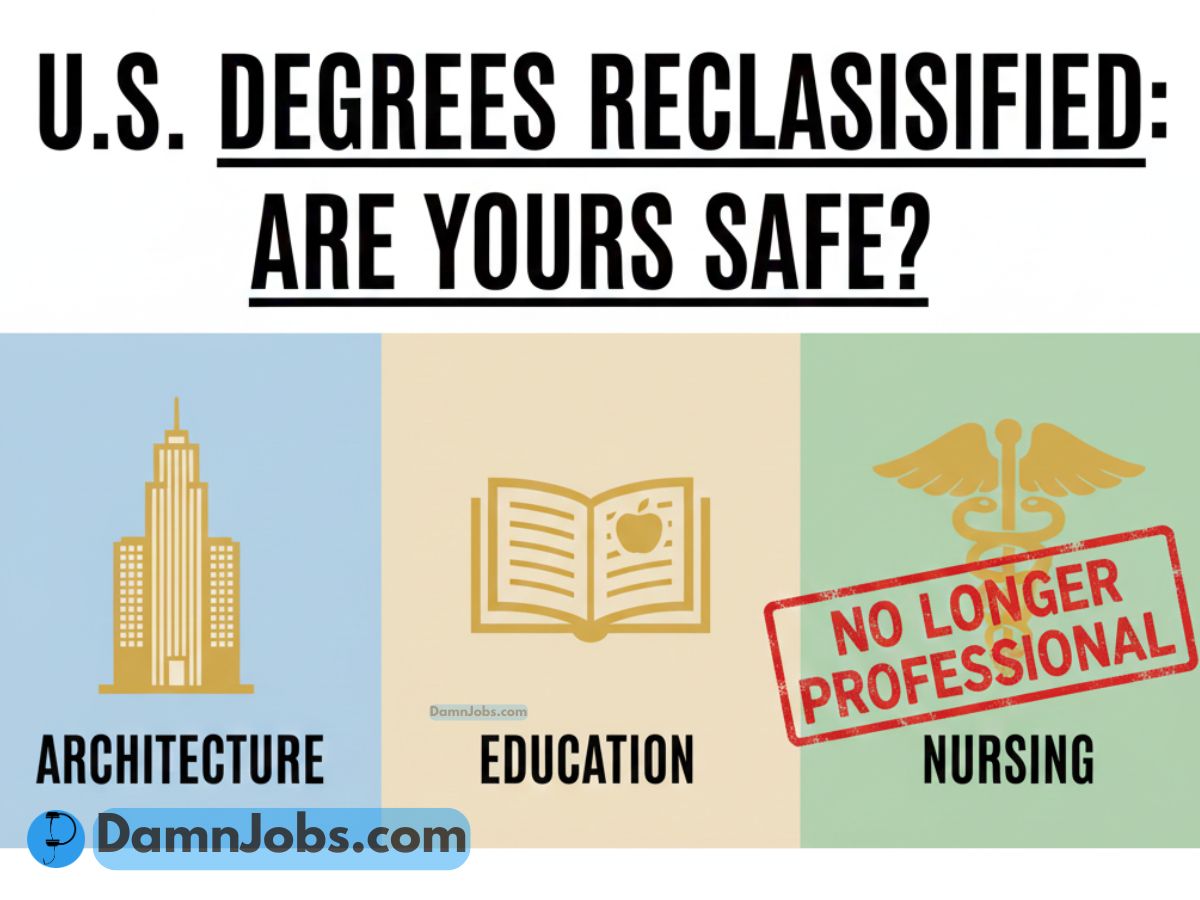
The U.S. government has announced a massive policy shift that will impact thousands of graduate students starting July 1, 2026. Certain rigorous fields—including architecture, education, nursing, physical therapy, dental hygiene, occupational therapy, and social work—will no longer be classified as professional degrees under federal lending guidelines.
This reclassification is highly significant because it directly limits how much federal loan money students can borrow to fund their education.
What’s Changing?
President Donald Trump’s One Big Beautiful Bill Act will replace older student loan structures and introduce the new Repayment Assistance Plan (RAP).
Under the new rules set by the U.S. Department of Education, loan caps are strictly tied to whether a program is defined as a “professional degree.” Here is the breakdown:
If your degree is NOT considered “professional”:
- You can borrow up to $20,500 a year.
- You are capped at $100,000 total.
If your degree IS a “professional degree”:
- You can borrow up to $50,000 a year.
- You are capped at $200,000 total.
Previously, graduate students relying on programs like the Grad PLUS loan could borrow up to the full cost of their attendance, regardless of the price of tuition.
Now, students pursuing vital careers—especially in nursing and architecture—may not have enough federal loan money to finish their expensive, intensive programs.
Why Are People Upset?
Architects Are Pushing Back
The American Institute of Architects (AIA) strongly opposes this decision. They emphasize that becoming a licensed architect requires years of demanding coursework, extensive exams, and a rigorous licensing process.
They warn that the lower loan limits will:
- Make it significantly harder for future students to afford entering the field.
- Reduce the number of trained, licensed architects.
- Hurt the U.S. design and construction industry.
Nursing Leaders Are Worried Too
The American Association of Colleges of Nursing (AACN) (a prominent American association) says the new rules could devastate the nursing workforce, which is already struggling with severe shortages.
Advanced nursing programs are lengthy and costly, and the vast majority of graduate nursing students rely on federal loans to complete their clinical training.
If students cannot borrow enough to cover tuition and living expenses:
- Fewer people will pursue advanced nursing degrees.
- Hospitals will face exacerbated staffing shortages.
- Overall patient care quality could drastically suffer.
More Degrees May Also Be Affected
According to recent reports, other intensive graduate programs at risk of losing their “professional degree” federal lending status include:
- Engineering
- Counseling and Therapy
- Speech Pathology
- Master of Business Administration (MBA)
Because some details of the regulatory guidelines are still being ironed out, further changes to the eligible list may still occur.
What This Means for Students
If you are planning to pursue a graduate degree in any of these fields, here is the new reality you may face:
- Strictly capped federal loan limits.
- An increased reliance on higher-interest private loans.
- Significantly higher out-of-pocket tuition costs.
- A tougher time financing the entirety of your education.
Ultimately, this change could make certain careers far less affordable for aspiring professionals across the country.
Summary
The U.S. government is enacting sweeping changes to the rules governing federal student loans. Under the new definitions, many rigorous degrees—like nursing, teaching, and architecture—will no longer be classified as professional programs. As a result, students pursuing these vital fields will not be able to borrow as much federal money to pay for school.
Major universities, nursing associations, and architectural groups are actively urging the government to reconsider this exclusionary decision before the new limits take full effect.